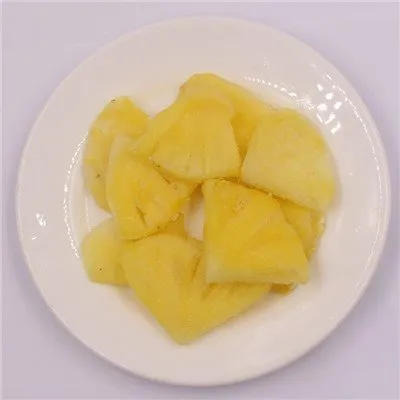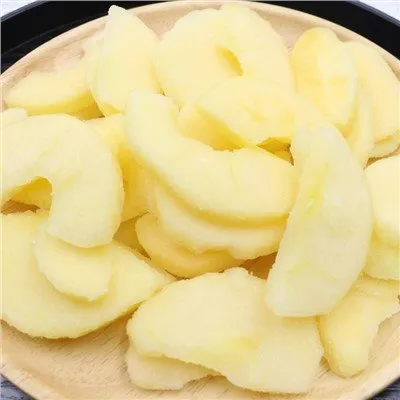
After the raw material is pretreated, it directly enters the freezing system. Depending on the product usage and freezing equipment, pre-packaging or post-packaging freezing can be used. Freezing systems are discontinuous (batch), semi-continuous and continuous pipeline. Commercially used freezing equipment includes:
①Blowing freezer, mainly using fluidized freezer (disk type or belt type) and fixed blowing freezer;
②The metal surface contact freezer mainly adopts horizontal plate freezer and particle freezer;
③The liquid evaporative freezer mainly adopts the horizontal liquid nitrogen freezer. The choice of freezing system should be considered from product quality and economy. The effects of freezing system on product quality are freezing speed and dry consumption.
Using the method of freezing before packaging, most of them use a fluidized bed to achieve quick-freezing of fruits, and the obtained products are loose. Under the temperature of -26~-30℃, when the product is placed at a thickness of 30~40mm, the freezing time of blueberries, raspberries, strawberries and cherries is only 4~15min. The freezing speed of the liquid nitrogen freezing method is fast, and the ice crystals are extremely small, which is especially suitable for berries with soft tissues. During production, the fruit is transported into the quick-freezing tunnel by the conveyor belt, sprayed with liquid nitrogen, and frozen immediately. For example, the freezing time of strawberry from 20 ℃ to -18 ℃ is only 2 minutes, and the tissue state of strawberry changes very little. After 90 minutes of thawing, the loss of juice is 50% lower than that of the single quick-frozen product, but the cost is higher. The method of freezing after packaging is suitable for: ① bulk freezing of sweetened fruits; ② freezing of soft fruits like raspberries and overripe fruits such as strawberries; ③ retail packaging frozen with syrup or sugar. The freezing system mostly adopts horizontal aluminum plate freezer (if forced circulation is used, the surface temperature of the plate is -4°C, and the freezing time is about 30min when the packaging thickness is 25mm) and fixed blowing freezer (air temperature is usually -38~- 40℃, wind speed 4~7m/s).
Fruit quick-freezing process The general processing process of quick-frozen fruit is: raw material selection, cleaning, grading, shaping treatment (such as peeling, pitting, cutting, etc.), adding sugar, adding vitamin C and other protective agents, packaging (or bulk), quick-freezing , Frozen.
The properties of the fruit raw material play a decisive role in the quality of the finished product. The fruits used for freezing should be suitable for freezing and preservation. After thawing, the original tissue state and brittleness are basically maintained, and the ripening is moderate, the appearance is neat, and it is not easy to oxidize and change color. Commonly used fruits are peach, apricot, pear, apple, plum, strawberry, raspberry, melon, cherry, mango, pineapple, kiwi and so on. The purpose of adding sugar is to prevent a large amount of water from freezing and destroy the tissue of the fruit, and to prevent the oxidation of the air, weaken the activity of oxidase, and avoid discoloration of the pulp, which is an important step to maintain the quality of the fruit. Soak the fruit with 2-4% vitamin C solution for dozens of minutes and then freeze it, which can make the color of the quick-frozen fruit similar to the fresh fruit. Before packaging or individual quick freezing, it should be drip-dried with a shaking dewatering device. The pH value of fruit is 2.5 to 5.0, so the pretreatment equipment is required to be made of stainless steel.